
Recently having had the privilege of hearing a family describe the impact of the birth of their new baby – I was struck as one of them used the word “power” that this beautiful, sometimes messy and noisy but wonderful little bundle of joy possessed.
They obviously didn’t mean power as in force or the strength of physicality; or power as in wealth or prestige, but power just to stop us in our tracks, that awakens in us beyond words – a deeply rooted reaction for the preciousness of life of love and a gift that puts everything in perspective and fills us with awe and gratitude, from little young siblings of the new born to the oldest generation of the family, who approach the cot with a sense of joy and quiet wonder.
On this great feast day, we are invited to approach the crib with that same sense of awe, joy and quiet wonder. God appears as a child, for us to pick up.
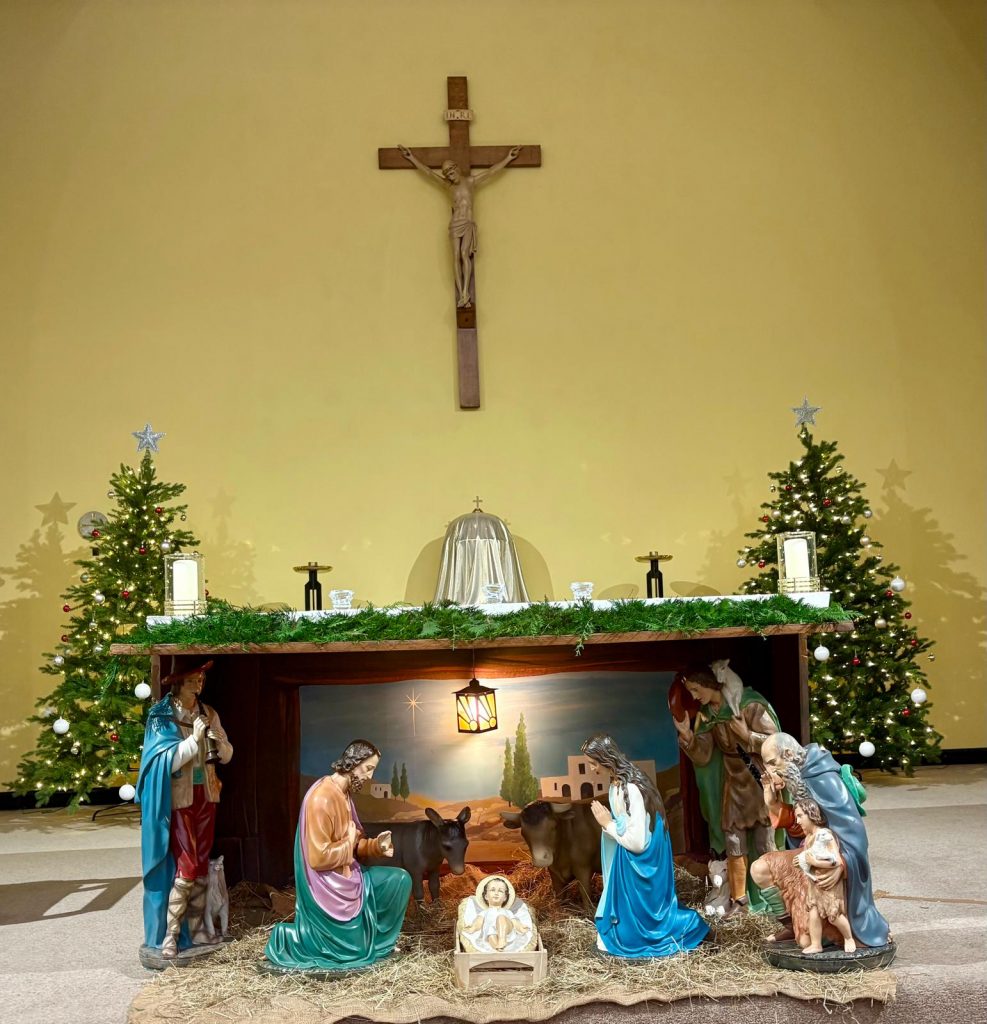
I like the nativity scene – I usually find I pray in this season with fewer distractions as I can sit in church and simply contemplate the domestic, family scene depicting God born for us in Jesus, God revealing himself to us as a child in such a way that never intimidates and only speaks of mercy and love.
It’s St Francis of Assisi we have to thank for the traditional nativity scenes that we perhaps take for granted. Francis had been struck by the paintings of the Nativity that he had seen in the Basilica of St Mary Major in Rome and he asked Giovanni Velita in Greccio, Northen Italy to prepare a scene with animals and a hay-filled manger.
And that’s what he got -a scene constructed initially, not with statues of Mary and Joseph and Jesus and Shepherds and Kings but rather a real-life Oxen and a real-life donkey and a manger filled with hay, where worshippers could go and sit and place themselves there in the middle of it, as a way of knowing that the birth of Jesus is as real for us now as it was in Bethlehem.
And not only that; at that first Nativity scene St Francis and his companions celebrated Mass there over the manger, to echo the truth that Jesus who is placed in an animal’s feeding trough, is the bread of life, his very self, that he offers to us in the Eucharist as food for the journey through life.
We are invited year by year to place ourselves in the warm, human, enticing domestic scene of the crib – I’m not suggesting that we form an orderly queue, but just as at Grecchio with St Francis, we too are literally invited to experience the Nativity scene, with no distance between the original event and us here and now. What matters is that it speaks to our lives.
Wherever it is, and whatever form it takes, the Christmas crèche speaks to us of the love of God, the God who became a child in order to make us know how close he is to every man, woman and child, regardless of how we are this year or whatever joys and sorrows we carry with us.
And beyond the sentimentality of Christmas, the power of Christmas is not automatic. The power of the Christ child we celebrate can’t be taken for granted. It has to be given birth in us, in the ups and downs of life.
The baby Jesus doesn’t save the world, the adult Christ does, as the wood of the manger points to the wood of the cross. Our task is to turn the baby Jesus into the adult Christ in our own bodies and with our own lives.
We need to go into the manger and awaken the child. We awaken the Christ-child when we smile at charity, joy, peace, patience, goodness, longsuffering, fidelity, gentleness and compassion until like any baby he smiles back at us.
What comes back is the power of Christmas, a baby’s power to change lives hidden in human frailty. And in that frailty is the power and love of God.
Happy Christmas!
Fr Steven